Legal support that brings healthcare innovation to life.
Nixon Law Group helps digital health innovators launch, grow, and scale their companies. Working at the intersection of healthcare law, strategy, and technology, we’re a law firm as forward-thinking as the clients we serve.
The NLG Difference:
We're laser-focused on healthcare.
The NLG Difference: We're laser-focused on healthcare.
You’re making major decisions and taking on big bets. You need a legal team that understands the space and the stakes. Together, we’ll turn your bold ideas into impact.
Expertise
We speak the language of healthcare and innovators.
Actionable
Legal strategies built to accelerate results.
Partners
Together, we navigate the path from innovation to impact.
Medical Devices
|
Artificial Intelligence
|
Remote Patient Monitoring
|
Digital Therapeutics
|
Telehealth
|
Virtual Veterinary
|
Women's Health
|
Behavioral Health Tech
|
Food as Medicine
|
Medical Devices | Artificial Intelligence | Remote Patient Monitoring | Digital Therapeutics | Telehealth | Virtual Veterinary | Women's Health | Behavioral Health Tech | Food as Medicine |
We serve the innovators
driving healthcare forward.
Digital
Health
From seed stage to IPO, we help you grow, stay compliant, and earn investor trust.
Providers &
Payers
We translate innovation into operational reality, without compromising compliance.
VCs &
PortCos
We help you evaluate, protect, and accelerate your healthcare portfolio.
-
"We certainly feel tremendous value working with you and not just value but also comfort having you as our partner. We absolutely want to renew and keep working together."
CEO, Virtual Care Company
-
"We are so impressed with your in-depth knowledge and are grateful to be working with you."
Remote Patient Monitoring Client
-
"Your knowledge in this [RPM] space consistently exceeds that of everyone else we talk to, and it is an absolute advantage for us to have you guys on our side!"
CEO, Telehealth Company
-
"Great job handling the terms of the contracts and providing stiff legal responses when needed! (Even their procurement team gave you props a few times on our conference calls)."
Virtual Care Client
-
"I feel a sense of relief as I have long been looking for the right people that understand the complexities of the telehealth and RPM landscape and can help us figure out how to build our business models."
CEO, Pediatric Physical Therapy
Telehealth Solutions -
"We are so happy to have found your group. You have made this whole process so much easier and we would not be where we are right now without your help."
Cofounder, Medical Device Company
Our Insights:
Legal intelligence for healthcare innovators.

The MSO-PC model is facing increased regulatory scrutiny in 2026. This article explains the proposed Stop Corporate Takeovers of Physicians Act, California SB 351, recent Attorney General enforcement, OHCA developments, and what digital health companies should review now.

Behavioral HealthTech is entering a new era of AI regulation, patient-safety obligations, and digital health reimbursement. Explore FDA/SaMD boundaries, AI risk governance, FTC health-data privacy, DMHT and RTM billing pathways, and the key diligence issues boards, founders, and investors should address in 2026.

CMS has proposed national Medicare pricing for health and well-being coaching (CPT codes 0591T–0593T) starting in CY 2027. While this creates a promising reimbursement pathway under physician supervision, health coaches cannot bill independently, and crucial operational questions around supervision levels remain unresolved. Explore what healthcare organizations, ACOs, and CBOs need to know to prepare.

Navigating rapid growth, enterprise contract negotiations, or AI integration in digital health requires executive compliance leadership—without six-figure full-time overhead. A Fractional Chief Compliance Officer (CCO) from Nixon Law Group gives startups embedded expertise to manage HIPAA, CPOM, billing integrity, and investor diligence on a flexible retainer basis.

In OIG Advisory Opinion 26-16, regulators declined to sanction an FQHC’s Food as Medicine program, offering crucial guidance for digital health companies, health systems, and payors. While free produce triggers Anti-Kickback Statute (AKS) and Beneficiary Inducements CMP risks, OIG exercised enforcement discretion due to strict clinical oversight, financial-need screening, and operational safeguards. Nixon Law Group breaks down the 5 key compliance principles needed to safely structure Food as Medicine and SDOH initiatives.
The CY 2027 Physician Fee Schedule (PFS) proposed rule represents the most significant shift to remote monitoring since its inception. CMS proposes to dismantle the third-party clinical staffing model by mandating direct employment for RPM and RTM billing, introducing mandatory initiating visits, and slashing code valuations. Discover how these regulatory shifts affect your digital health operations and how to submit public comments before the September 14, 2026, deadline.
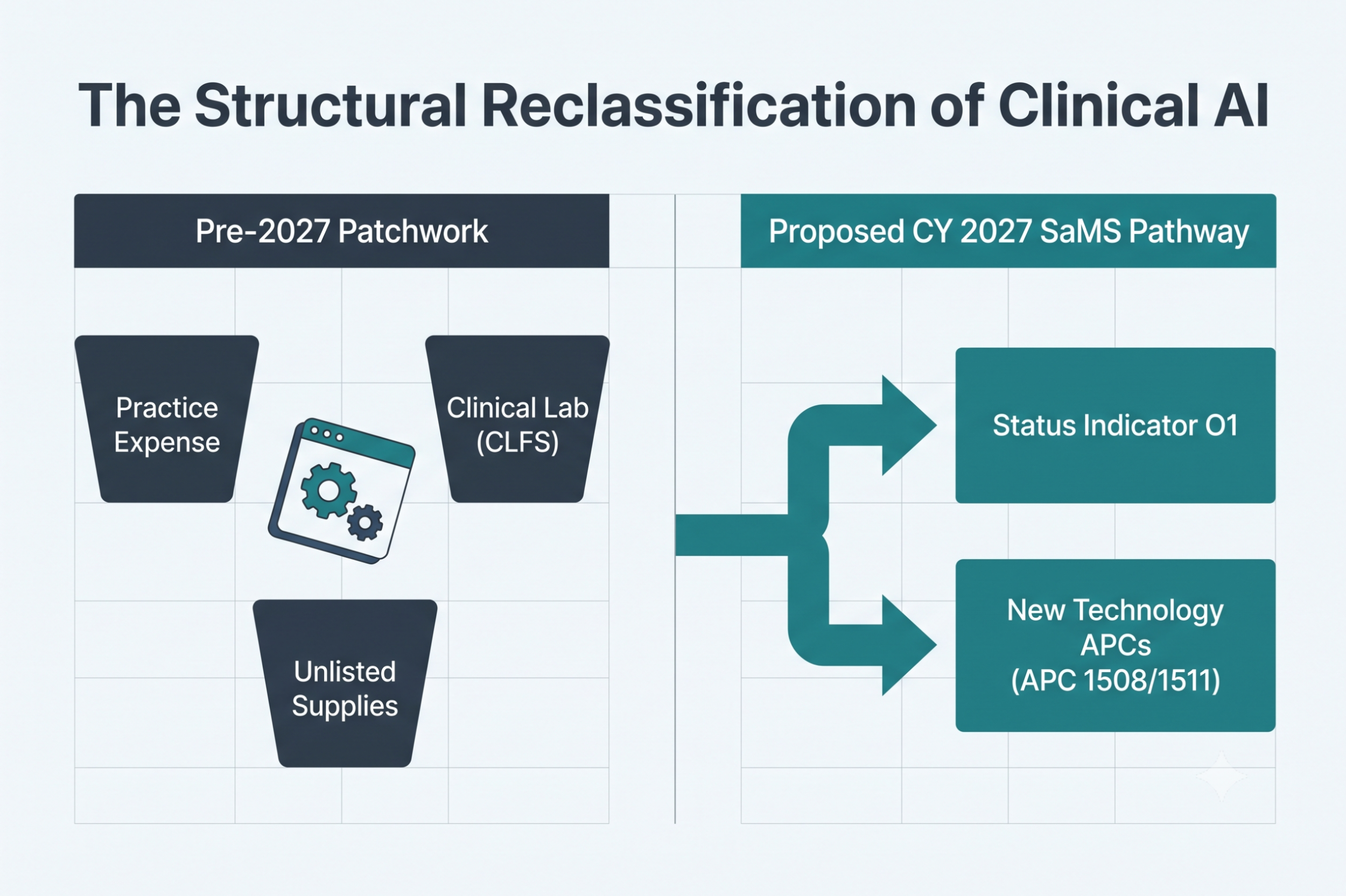
The CMS CY 2027 OPPS Proposed Rule introduces Software as a Medical Service (SaMS), a proposed Medicare reimbursement pathway for qualifying clinical AI and software-based medical technologies. Learn how the new O1 Status Indicator, New Technology APC payments, and updated reimbursement policies could reshape commercialization strategies for digital health companies, healthcare providers, and investors.

CMS's 2027 Medicare Physician Fee Schedule proposed rule introduces sweeping changes for digital health, telehealth platforms, AI-enabled care, remote patient monitoring (RPM), remote therapeutic monitoring (RTM), software-based medical services, interoperability, and physician reimbursement. This comprehensive analysis explains the proposed BB/BC telehealth modifiers, the potential end of third-party RPM staffing models, CMS's new Software as a Medical Service (SaMS) framework, AI-focused requests for information, and the opportunities for digital health companies to influence the final rule before comments close on September 14, 2026.

Digital health and wellness companies need more than occasional legal advice—they need strategic legal leadership that understands healthcare innovation. Nixon Law Group’s Fractional General Counsel services provide HealthTech companies, telehealth providers, wellness innovators, and healthcare investors with ongoing access to senior legal guidance without the cost of a full-time General Counsel. From regulatory compliance and privacy to contracts, reimbursement strategy, AI governance, and investor diligence, a Fractional GC helps growing companies build scalable legal foundations.

Does adding AI to healthcare software automatically trigger FDA regulation? Not necessarily. This article examines the FDA's 2026 WHOOP closeout letter and UpDoc's 510(k) clearance to explain how the agency evaluates AI-enabled digital health products based on intended use, clinical risk, software functionality, user interface design, and validation—not simply the use of artificial intelligence. HealthTech founders, software developers, investors, and regulatory professionals will gain practical guidance on FDA General Wellness enforcement discretion, Software as a Medical Device (SaMD), AI governance, and product design strategies that can influence whether software remains a wellness product or becomes an FDA-regulated medical device.

Can digital health companies pay physicians and other clinicians royalties tied to platform revenue, product sales, or adoption? In OIG Advisory Opinion 26-10, the Office of Inspector General rejected a proposed clinician royalty arrangement despite fair market value safeguards, finding that physician influence over product utilization created Anti-Kickback Statute concerns. This article explains the OIG's reasoning, key compliance lessons, and what digital health, clinical AI, RPM, RTM, telehealth, and health tech companies should know before structuring clinician compensation arrangements.

The OIG’s April 2026 audit report signals heightened Medicare enforcement for virtual check-ins and e-visits. Digital health providers face increasing scrutiny over timing violations, duplicative billing, Modifier 25 misuse, and improper reimbursement for communication technology-based services (CTBS). This article breaks down the OIG’s findings, CMS’s response, and the key compliance steps digital health companies should take now to reduce audit risk and prepare for stricter claims oversight.

Can AI or a general business attorney handle legal and regulatory issues for your digital health company? In this article, Carrie Nixon explains why health tech startups, telehealth companies, and digital health platforms face unique risks involving HIPAA, Corporate Practice of Medicine (CPOM), Stark Law, Anti-Kickback Statute compliance, healthcare data privacy, reimbursement structures, and AI governance. Learn where AI tools can help health tech founders—and where experienced healthcare legal counsel is essential.

Healthcare generative AI has entered a new regulatory era in 2026. This guide breaks down the core framework leaders need to understand—from FDA medical device rules and HIPAA obligations to FTC enforcement and fast-evolving state laws. Learn how key design choices—such as generative vs rules-based AI, chatbots vs autonomous agents, and clinical vs administrative use—directly shape compliance requirements, risk exposure, and go-to-market strategy.

In 2026, leading Healthcare AI companies are transforming legal and regulatory strategy into a powerful go-to-market lever. From state-level regulatory sandboxes to evolving FDA Clinical Decision Support (CDS) guidance and CMMI reimbursement models, this post explores how companies can accelerate market entry, generate real-world evidence, and build a durable competitive moat.

Is your MSO-PC model truly compliant? The March 2026 NaphCare investigation by the New York OAG resulted in $875,000 in penalties, highlighting the dangers of "nominal" professional corporations and clinical interference.
Key Takeaways for Digital Health:
Clinical Autonomy: Why the PC must control all workflows.
Operational Separation: Avoiding the "Alabama Trap" of shared leadership.
NY CPOM Strictness: Why template-based compliance fails in New York.
Read our full analysis of the NaphCare case to protect your telehealth enterprise from regulatory scrutiny.

The CMS ASPIRE Model (Accelerating State Pediatric Innovation Readiness and Effectiveness) is a landmark 10-year initiative launched in 2026 to transform pediatric care for Medicaid and CHIP beneficiaries. By moving from Fee-For-Service to a Value-Based Care (VBC) framework, ASPIRE incentivizes "whole-person" health for youth up to age 21. For digital health innovators, the model creates a critical demand for interoperable care management, AI-driven risk stratification, and unified care plans that bridge clinical, school, and home environments.

The OIG’s 2026 Work Plan includes a major audit of Medicare Chronic Care Management (CCM) services, focusing on eligibility, documentation, and vendor oversight. With rising Part B payments, regulators are targeting compliance risks tied to “multiple chronic conditions” requirements. This article outlines key audit triggers, common red flags, and how care management companies and investors can proactively strengthen compliance ahead of federal scrutiny.

The Centers for Medicare & Medicaid Services ACCESS Model may seem like a reimbursement downgrade from traditional Virtual Care Management—but it could be the missing link in tech-enabled chronic care maintenance. Instead of rewarding episodic, labor-intensive interventions, ACCESS supports continuous, AI-enhanced oversight that keeps stabilized patients engaged and reduces readmission risk. Here’s why this shift could redefine scalability in value-based care.

In 2026, compliance is a competitive advantage in women’s health and FemTech. This article breaks down five critical pillars founders must address—from reproductive data privacy and FDA regulation to AI governance, corporate practice of medicine, and intellectual property strategy—to build trust, attract investment, and scale responsibly.

Is your digital health privacy strategy keeping pace with your technology? On National Privacy Day, we explore why privacy is a core business driver for telehealth, AI, and RPM innovators. From navigating the intersection of HIPAA and state consumer health laws to managing AI data governance and FDA cybersecurity, discover the five critical questions every healthcare leader must answer to ensure compliance, investor confidence, and long-term scalability.

In January 2026, FDA issued major updates to its Clinical Decision Support and General Wellness guidance, signaling a more innovation-friendly approach to generative AI, clinical copilots, and consumer wearables. This post explains what changed, which AI tools can now remain outside FDA regulation, and how digital health companies can design for compliance while accelerating time to market.

CMS’s new MAHA ELEVATE Model offers $100M in funding to evaluate evidence-based lifestyle, functional, and whole-person care interventions not currently covered by Medicare. Launching in 2026, this initiative creates a pathway for healthcare innovators, digital health companies, and care organizations to influence future Medicare coverage and reimbursement for chronic disease prevention and management.

The CMS CY 2026 MPFS Final Rule ends simplified G-code billing (G0071, G0512) for safety net providers. FQHCs and RHCs must shift to granular CPT/HCPCS coding for virtual check-ins, Chronic Care Management (CCM), and Behavioral Health Integration (BHI). This structural change is a major product roadmap update for digital health vendors serving the rural and community health market. Learn the 4 key billing changes to maintain revenue for your RHC/FQHC partners.

FDA’s new TEMPO pilot creates a flexible, real-world evidence pathway for digital health, SaMD, DTx, wearables, and AI-enabled devices—aligned with CMS’s ACCESS model. Learn how innovators can use enforcement discretion to deploy faster, collect RWD/RWE, and strengthen future FDA submissions.

The CMS ACCESS Model is a 10-year Medicare payment demonstration promoting outcomes-based reimbursement for chronic care management. For digital health vendors—from remote monitoring and wearables to interoperability platforms—the accompanying ACCESS Tools Directory creates a critical, new entry point into the Medicare ecosystem. This post breaks down the shift to Outcome-Aligned Payments (OAPs) and provides a compliance-forward strategy for listing your technology in the Directory to gain visibility and establish trust with Access Model Organizations (AMOs) before the July 1, 2026, launch.

HIPAA compliance is more than encryption and security controls—it requires a scalable privacy program that matures as your digital health company grows. Learn how Privacy Risk Assessments, BAAs, staff training, and patient-rights workflows create a competitive advantage in today’s health tech landscape.

The final 2026 Medicare Physician Fee Schedule (MPFS) solidifies Medicare’s shift toward paying for the assessment and mitigation of "upstream drivers" (e.g., nutrition, housing, social support). Discover how the revised HCPCS G0136 for physical activity/nutrition assessment and the broadened HCPCS G0019 descriptor for Community Health Integration (CHI) unlock new, aligned reimbursement streams for digital health and comprehensive care models. Also, learn how MFTs and MHCs can now initiate CHI services.

On November 6, 2025, the FDA’s Digital Health Advisory Committee delivered a clear message to the generative AI DMH sector: expect greater structure and tighter oversight. This article breaks down the 6 key themes—including the need for a new risk taxonomy, model drift management, and clinician-supervised use—and provides 5 immediate actions developers, deployers, and investors must prioritize to navigate the evolving regulatory landscape.

States are rapidly passing new laws to regulate Artificial Intelligence (AI) in healthcare, covering everything from mental health chatbots to AI-generated patient communications. The enforcement landscape is fragmented: some states rely on high administrative fines (up to $\$15,000$ per day), others empower Medical Boards, and some even grant a private right of action for consumers. For national digital health solutions, this patchwork of risk requires immediate mapping and proactive AI governance.
Transforming healthcare?
Let’s do it right.
Tell us where you’re headed. We’ll help you build the legal foundation to get there.